When Ubisoft released The Crew in 2014, the ambition was undeniably high. The goal was to build a seamless, scaled-down, open-world recreation of the entire contiguous United States, serving as a massive playground for street racers. It promised to merge the arcade thrills of Need for Speed with the persistent online world mechanics of an MMO. Looking back at it in 2022, especially after major expansions like Wild Run and Calling All Units, the vision remains impressive in scope even if the original execution had notable rough edges.
At its core, The Crew attempts to sell the ultimate automotive fantasy: picking a direction on a map and driving for hours across diverse biomes with your friends. However, wrapping that freedom inside a stereotypical B-movie revenge storyline, with one of the worst stories I’ve experienced, complete with undercover FBI agents, underground crime syndicates, and cringey dialogue creates an immediate tension between open-world exploration and forced campaign structure.
Let’s analyse my favourite points to review the game:
- Presentation & Atmosphere
The scaled-down map of the United States is an incredible achievement in world design. Driving from the neon-drenched streets of Miami through the swampy Bayou, up to the snow-covered Rocky Mountains, and down into Los Angeles offers an unmatched sense of scale and geographic diversity. The lighting updates introduced over time significantly enhanced environmental atmosphere, and listening to radio stations while cruising down endless highways captures a genuine road-trip mood.
On the flip side, graphical fidelity is inconsistent when examined closely. City streets can feel static and lifeless, traffic AI behaves unnaturally, and low-resolution textures on secondary buildings stand out during slow driving. The visual clutter from the HUD, that look it got out a mobile game, overflowing with pop-up challenges, waypoint lines, and player tags, frequently distracts from the scenery, while the narrative writing remains painfully generic and full of clichés.
Score: 1.5 / 2
- Engagement & Reactivity
At launch, the vehicle handling was heavily criticized for feeling floaty and unresponsive, but post-launch physics tweaks vastly improved the driving feel. The core loop of customizing cars into distinct specs (Street, Dirt, Perf, Raid, and Circuit) adds genuine variety to how vehicles handle different terrains. Darting through off-road forests in a Raid spec monster machine feels weighty and distinct compared to weaving through traffic in a low-slung Perf spec supercar.
Where the driving loop falls flat is in its combat-oriented mission design and rubber-banding AI. Takedown missions force players to ram runaway targets with loose collision physics, leading to frustrating resets when hit-boxes misalign. Furthermore, rubber-band AI means computer opponents can magically catch up to you at 200 mph regardless of how cleanly you take corners, stripping away the satisfaction of a flawless racing line.
Score: 1 / 2
- Value & Mastery
In terms of pure landmass and activity density, The Crew offers tremendous content volume. Beyond the main campaign, the map is littered with quick skill challenges (slaloms, speed tests, jumps) that seamlessly reward loot parts. The car specs allow a single vehicle model to fulfil completely different racing roles, providing satisfying mechanical depth for players who like fine-tuning performance parts and visual customizations.
My main issues lies in the MMO-style loot system, which introduces artificial grinding walls. Performance parts are awarded with random RPG-like stats (Bronze, Silver, Gold, Platinum levels), forcing players to repeat short skill events dozens of times to optimize a single car. Car rosters also feel somewhat restricted compared to pure sandbox racers, and high car prices tempt players toward microtransactions rather than organic progression.
Still, you have the whole USA. I’ve always wanted to visit, and for sure, it gives me the vibes that I would want in a grand tour in the country.
Score: 2 / 2
- Polish & Readiness
You drive across the entire map without a single loading screen, which is remarkable. Frame rate stability on PC and modern consoles is generally solid during standard freeroam, and fast-traveling across state lines is surprisingly fast.
My only issue is the game’s strict always-online requirement is its biggest structural flaw. If your internet connection stutters or Ubisoft servers experience hiccups, you get instantly booted to the main menu, losing all current mission progress regardless of whether you were playing solo.
Score: 1 / 2
- Respect & Structure
The world map interface is masterfully designed, allowing players to zoom from a micro-view of their car smoothly out to a satellite view of the entire nation. Tutorials are kept relatively brief, allowing players to get out on the open road quickly. Jump-in cooperative matchmaking for story missions makes tackling tough races with online crewmates frictionless.
Despite the slick map UI, campaign pacing is severely dragged down by level gating. You will frequently hit story walls where your car’s “Performance Level” isn’t high enough, forcing you to stop progressing and grind skill tasks or side races. Combined with aggressive police AI that can feel unfairly punishing during long escape events, the game structure regularly penalizes player momentum.
Score: 1 / 2
Bonus: Couch Co-Op
Despite heavily emphasizing the concept of forming a “Crew” with your friends to conquer the country, the game relies entirely on online multiplayer.
There is zero local split-screen functionality available, completely omitting couch co-op in an arcade racer where driving together side-by-side on one TV would be fenomenal.
Score: -1 point
Platforms & Versions: Where Should You Play?
The Eighth-Gen console versions (PS4 and Xbox One) target a stable 30 FPS at 1080p, providing decent visual detail, though they lack the high frame rates essential for fast twitch steering adjustments. Handheld devices like the Nintendo Switch never received a port, but portable play is possible streaming via Remote Play.
The PC version is unquestionably the superior platform. It supports 60 FPS gameplay, higher draw distances (essential for spotting oncoming traffic during cross-country sprints), ultra-wide monitor support, and full wheel support, turning a rough console racer into a far crisper driving experience.
My Verdict on the BEST Version: The PC version is the definitive choice, offering the smoothest frame rates, extended draw distances for high-speed cruising, and full steering wheel setup support.
My Verdict
The Crew is a fascinating, massive experiment that mostly succeeds in delivering an epic, seamless open-world road trip across North America. Its technical achievement in map scale remains unmatched, but its RPG loot mechanics, rubber-band AI, cringey storyline, and mandatory always-online connectivity hold it back from greatness. It is a game best enjoyed not as a serious competitive racer, but as a relaxing, podcast-listening highway simulator with friends.
Final Score: 5.5 / 10
Badge: Store Badge
The Crew is a niche open-world racer with impressive scale but burdened by big structural flaws like always-online requirements, grinding progression, and clunky story missions. It belongs on digital storefronts as a history, because The Crew 2 is definitely the better improved game, but die-hard racing fans maybe wants to experience it on hands.
Collection Showtime
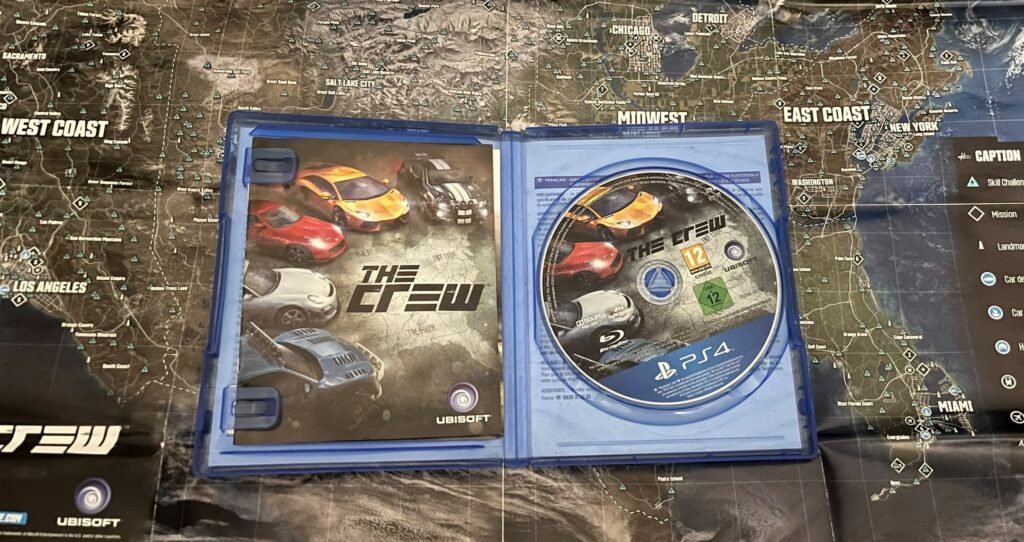
I really like this physical version. Besides the nice manual, the map is very cool, I wish they also had included on The Crew 2 🙁